Beaverton Wine Cellars · Services

Wine Cellar Cooling Systems in Beaverton

Beaverton Wine Cellars chooses and fits cooling equipment for wine cellars in Beaverton, whether the cellar is new or has a unit that no longer keeps pace. Unlike a comfort air conditioner, a cellar system is designed to sit near 55°F while leaving the humidity corks depend on, and the right one follows from the room’s heat load and from where the machine can dump its heat.

We plan and install cellar cooling throughout Beaverton and in Aloha, Raleigh Hills, West Slope, Cedar Mill and Bethany.

Request a cooling system quote

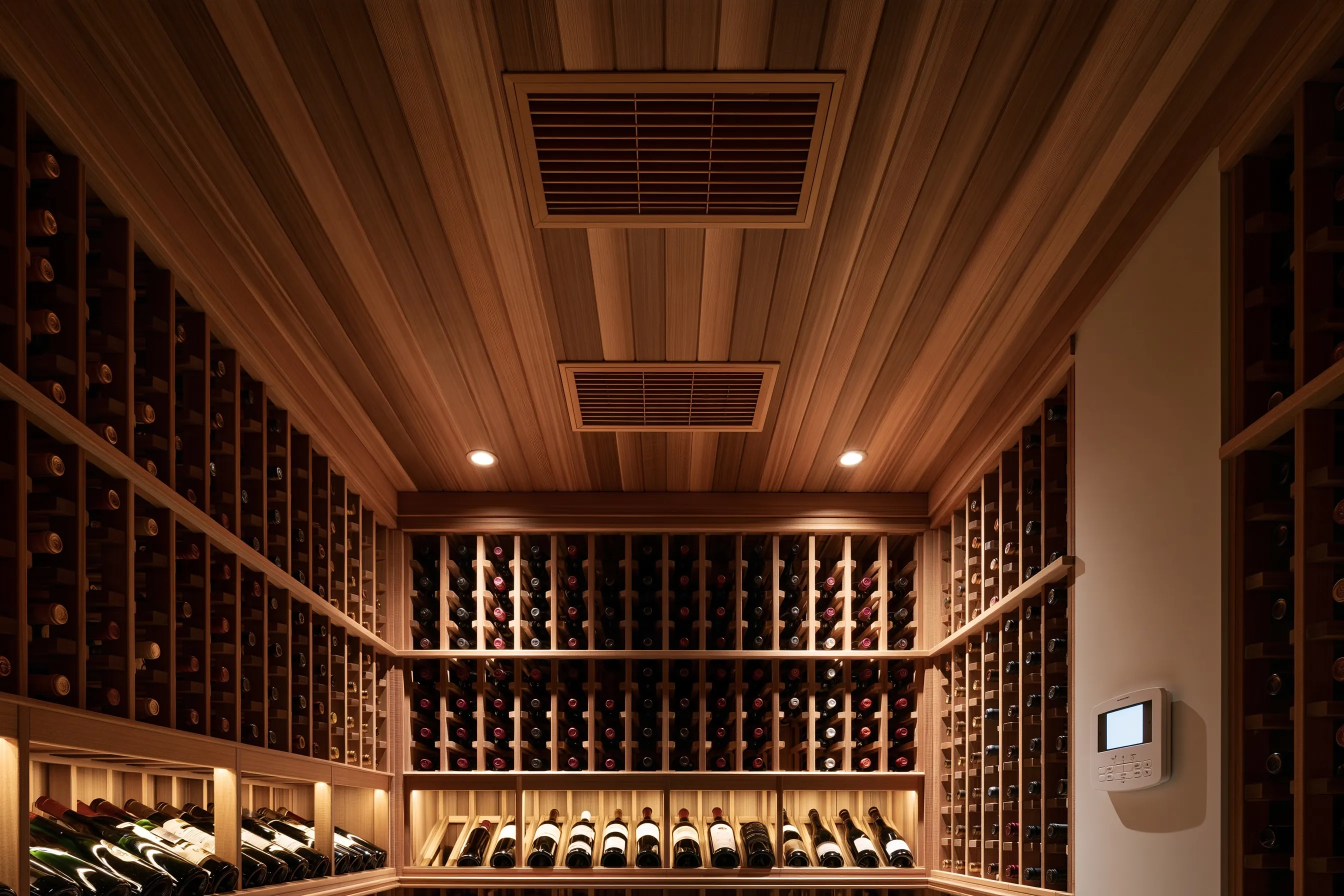
Finished wine cellar with a wood plank ceiling holding two cooling supply and return grilles, wood racking below and a wall controller

Wine cellar cooling system options

Self-contained through-wall units

Everything lives in one box set into the cellar wall: cold air leaves the front, heat leaves the back. Installation is the simplest of the options, though CellarPro needs the space behind to match or exceed the cellar’s volume and WhisperKOOL’s XLT guide wants that exhaust room ventilated and never above 85°F. WhisperKOOL describes venting through an exterior wall as possible but not recommended, allowable only where outdoor temperatures hold between 40°F and 85°F.

Ducted self-contained units

This is the single-box design moved to an attic, utility room or adjacent space and connected by ducts to supply and return grilles in the cellar. WhisperKOOL rates its ducted Phantom to keep 55°F provided its exhaust location stays within 42°F to 110°F, a wider window than a through-wall unit allows.

Split systems

WhisperKOOL insists on a certified HVAC-R technician to install its split systems, and the EPA’s Section 608 guidance requires technician certification when installation involves adding or removing refrigerant or connecting lines. The payoff is a quiet cellar: only the evaporator sits inside, while the louder condensing unit goes outdoors or to a ventilated room elsewhere, joined to it by refrigerant lines.

Ducted split systems

Both halves sit outside the room here: the evaporator connects by ductwork and the condenser is remote, so the cellar holds no visible or audible equipment. Wine Guardian names this arrangement as its preferred match for glass wine rooms, where getting rid of condenser air is otherwise awkward.

Replacing or upgrading an existing unit

A unit that runs constantly or leaks water may be reacting to the room rather than failing. CellarPro says a poorly sealed cellar makes its units build up excess condensation that can damage parts and leak, and WhisperKOOL links a poorly sealed door to continuous running. We check the envelope and recalculate the load before sizing a replacement.

Sizing and heat load

To keep up, the unit must deliver more cooling at cellar temperature than the room gains in heat. Heat gain rises with volume, glass and walls that face outdoors or warm rooms, and falls with better insulation and cooler surroundings. Manufacturer volume charts assume their own construction minimums; CellarPro’s assume R-19 throughout and an 85°F peak ambient, and glass or weaker walls call for a custom load calculation. Local stations log roughly 350 to 405 cooling degree days a year, yet the requirement is set by the hottest afternoons rather than the annual total.

Why not a home AC or mini-split?

Comfort systems and cellar systems are tuned for different targets. Wine Guardian, itself a cellar-equipment maker, writes that comfort mini-splits are optimized around 72°F, seldom reach 55–58°F, and keep humidity at or under 50%. Wine Spectator has no equipment to sell and reaches a similar verdict on window units: roughly 62°F is about as low as they go, and they can dry a room to around 35%, which risks cracked or crumbling corks.

Electrical, drains and permits

Circuit needs vary by model, from one dedicated 15-amp circuit for CellarPro’s 1800 series to separate dedicated 20-amp circuits for the indoor and outdoor parts of WhisperKOOL’s ceiling-mount split. Because cellar units pull moisture out as they cool, WhisperKOOL makes a drain line mandatory on the Phantom and on its ceiling-mount evaporator, and Wine Guardian’s ducted split manual offers an optional condensate pump. The final circuit design belongs to a licensed electrician working from the unit’s instructions and the electrical code.

Oregon’s state permit guidance calls for an electrical permit whenever permanent wiring is installed and lists mechanical permits for items like vented appliances; portable cooling units are exempt, and refrigeration is not specifically mentioned. Beaverton’s Building Division issues both electrical and mechanical permits, and we confirm with it whether a specific cellar unit needs the mechanical one.

Summer peaks and the exhaust room in Beaverton

At the Beaverton 2 SSW station, July and August highs average about 82°F and roughly 15 days a year reach 90°F or more. A garage or closed utility room can reach those temperatures too, and WhisperKOOL’s guide says that with a 95°F exhaust room the cellar can only reach about 65°F while the unit runs continuously. Breezaire’s instructions list garages and attics among inappropriate places for the warm-air exhaust of its self-contained units; ducted units such as WhisperKOOL’s Phantom are designed for attic or utility-room placement, within their rated 42–110°F.

Winter brings the opposite limit. The same station averages lows near 34°F in December and January and about 42 nights a year at or below freezing, below the 40°F floor WhisperKOOL gives for venting a unit outdoors. Equipment that rejects heat outside needs a rating for those conditions. Summers are dry, with a dew point near 53°F at Hillsboro airport, which keeps humidity’s added load lower than in muggier climates.

Frequently asked questions

Which type of cooling system do I need?

The deciding question is where the heat goes. With a temperate, ventilated room behind the cellar wall, a through-wall unit can work. If the nearest suitable space is an attic or utility room, a ducted unit fits. When heat has to go outdoors, or the cellar is mostly glass, a split or ducted split is the answer.

Can I use a regular mini-split?

Not as a cellar system. Comfort mini-splits are built for room temperatures and dry air, so they struggle to hold 55°F and remove the humidity corks rely on.

Does a cooling unit need its own circuit?

Of the manuals reviewed for this site, CellarPro and WhisperKOOL specify dedicated circuits, Wine Guardian dedicated outlets, and Breezaire a grounded outlet of adequate capacity. An electrician confirms the circuit for the chosen unit.

Request a cooling system quote

How big is the cellar, how much glass does it have, and what is on the far side of its walls? If a unit is already installed, tell us its type, and add the property address. We'll get back to you soon with an estimate or any questions we have. Estimates are free and there's no obligation.

Call (971) 265-8177

Call (971) 265-8177