Beaverton Wine Cellars · Services

Glass Wine Rooms in Beaverton

Beaverton Wine Cellars designs and builds glass wine rooms in Beaverton, walk-in cellars that let a dining room, living room or entry look straight into the collection through insulated glass walls and doors. Because a pane insulates far less than a framed wall, the glazing, the solid surfaces and the cooling are planned together as a single thermal problem.

We build glass wine rooms throughout Beaverton and in Aloha, Raleigh Hills, West Slope, Cedar Mill and Bethany, including glass fronts added to existing cellars and converted rooms.

Request a glass wine room quote

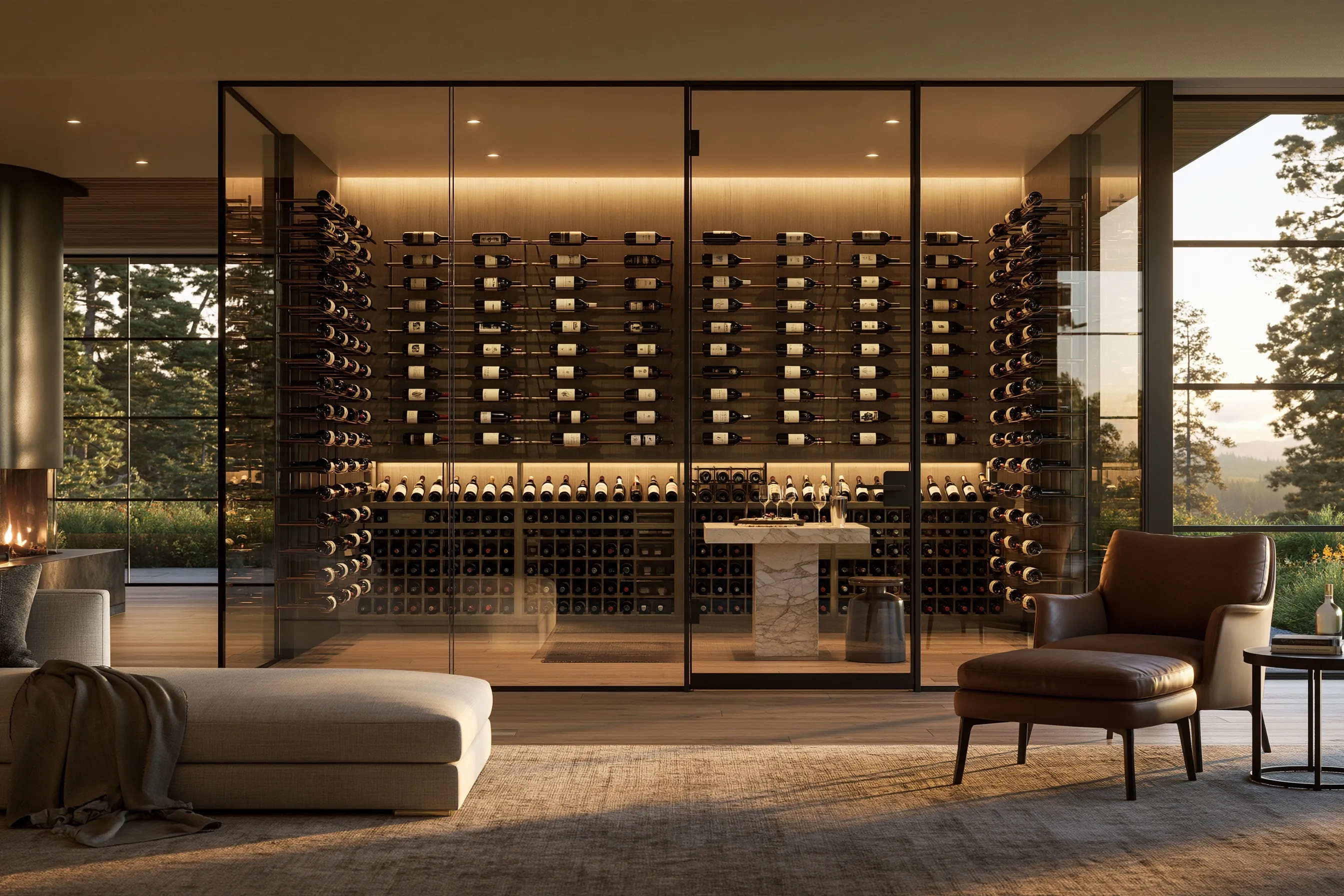
Living room with a floor-to-ceiling steel-framed glass wine room, metal rod racking inside and a marble tasting table

Glass wine room options

Walk-in glass wine rooms

A fully glazed room puts glass on one or more sides, while the ceiling, back wall and floor are still framed, insulated and vapor-controlled. Label-forward metal racking lets bottles read through the glass, and lighting is planned to show them without warming them.

Glass fronts on an existing room

A converted spare room or lower-level cellar can gain a glass wall or door on its most visible side while the other walls keep their insulation. That holds the heat load below an all-glass room and suits rooms whose remaining walls face storage space or the exterior.

Frameless versus framed insulated glazing

According to a Wine Guardian dealer’s blog, framed glass systems can take genuine double-pane insulated units and seal better, whereas frameless walls are built from single 3/8- to 1/2-inch tempered or laminated panels. The same blog gives about R-1 for one pane and roughly R-3 to R-4 for argon-filled low-E double glazing, and suggests UV-filtering glass to cut light exposure.

Glass doors and seals

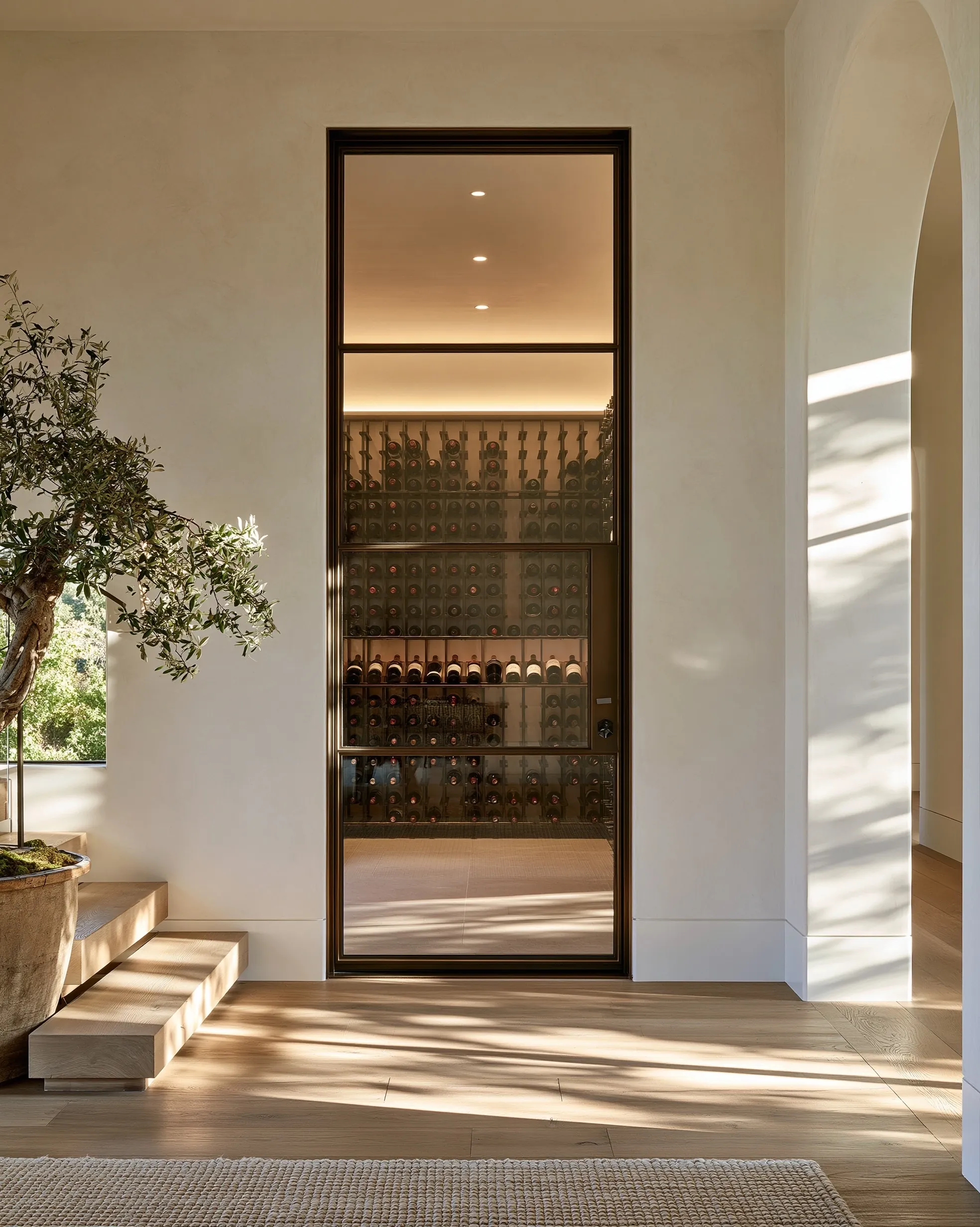
The door is the moving part of a glass enclosure, and its seal has to survive daily opening. Wine Guardian names insulated double-pane glass combined with exterior-grade doors and thresholds as the way to an airtight glass room, so the glass door gets perimeter seals and a sweep or threshold like any cellar door.

Full-height glass cellar door in a slim bronze frame within a plaster wall, lit racking visible behind the glass

Condensation and dew point

Guardian Glass describes condensation as forming on any glass surface whose temperature has dropped to the dew point of the neighboring air or lower, so it depends on that air’s humidity and on how cold the pane becomes. A cellar cools its glass from inside while the outer face meets house air, and insulated glazing keeps that outer face warmer than single glass can.

Cooling a glass room

Ask four cooling makers about glass and you get four answers. Breezaire wants no glass doors or windows at all in a cooled enclosure and does not size for them. WhisperKOOL accepts glass doors but recommends the next larger unit when the room is close to rated capacity. CellarPro warns its tables understate the load once glass is involved and calls for a custom calculation. Wine Guardian goes furthest toward glass, singling out ducted splits for glass rooms where condenser air has nowhere easy to go. We work from a calculated load, never a volume chart.

Lighting inside glass

In a glass room the lighting is on display, which makes it tempting to overdo. The dealer blog notes LED strips add little heat. A 2026 OENO One study found amber-filtered LED caused far less riboflavin breakdown, the cause of light-struck aroma, than cool-white light in clear-bottled white wine, though darkness protected best. Surface-mounted fixtures avoid the air leaks of recessed cans, and a timer or motion sensor keeps the lights off when no one is looking.

Glass in a Beaverton conversion

Summer is the season that tests glass here. Hillsboro airport normals put the July and August dew point near 53°F, only about 2°F below a 55°F cellar, so, by our reading of these figures, a single pane chilled close to cellar temperature leaves little margin against fogging on the room side, particularly in a house without air conditioning. Insulated double-pane glazing keeps the room-side surface well above that point.

July and August also average highs near 82°F at the Beaverton 2 SSW station, with about 15 days each year hitting 90°F, so glass adds heat at the moment the cooling is most stretched. A glass front on an existing basement or spare room therefore needs cooling sized for those afternoons; permits for any new walls or wiring follow the Oregon rules explained on our basement page and come from the City of Beaverton Building Division.
Frequently asked questions

Will the glass fog up?

The risk is low when the glazing suits the conditions. Fog appears when a glass surface reaches the dew point of the air beside it, and insulated double-pane low-E glass, a sealed door and steady cellar humidity keep the surfaces warmer and drier.

Can a glass wine room hold cellar temperature?

Yes, with cooling sized for the glass. Because the load can be far higher than a framed room of the same volume, the unit is chosen from a heat-load calculation.

Framed or frameless glass?

Frameless looks lighter but uses single panels; framed systems accept insulated double-pane units and seal more reliably, according to the dealer blog cited above. For a cooled room, insulated units are the safer thermal choice, especially on large walls.

Request a glass wine room quote

Which room would the glass wine room open onto, and how much glazing are you imagining? Send that with the property address. We'll get back to you soon with an estimate or any questions we have. Estimates are free and there's no obligation.

Call (971) 265-8177

Call (971) 265-8177